00:00
/
00:00
Why the B2B software shortlist decides who wins the deal
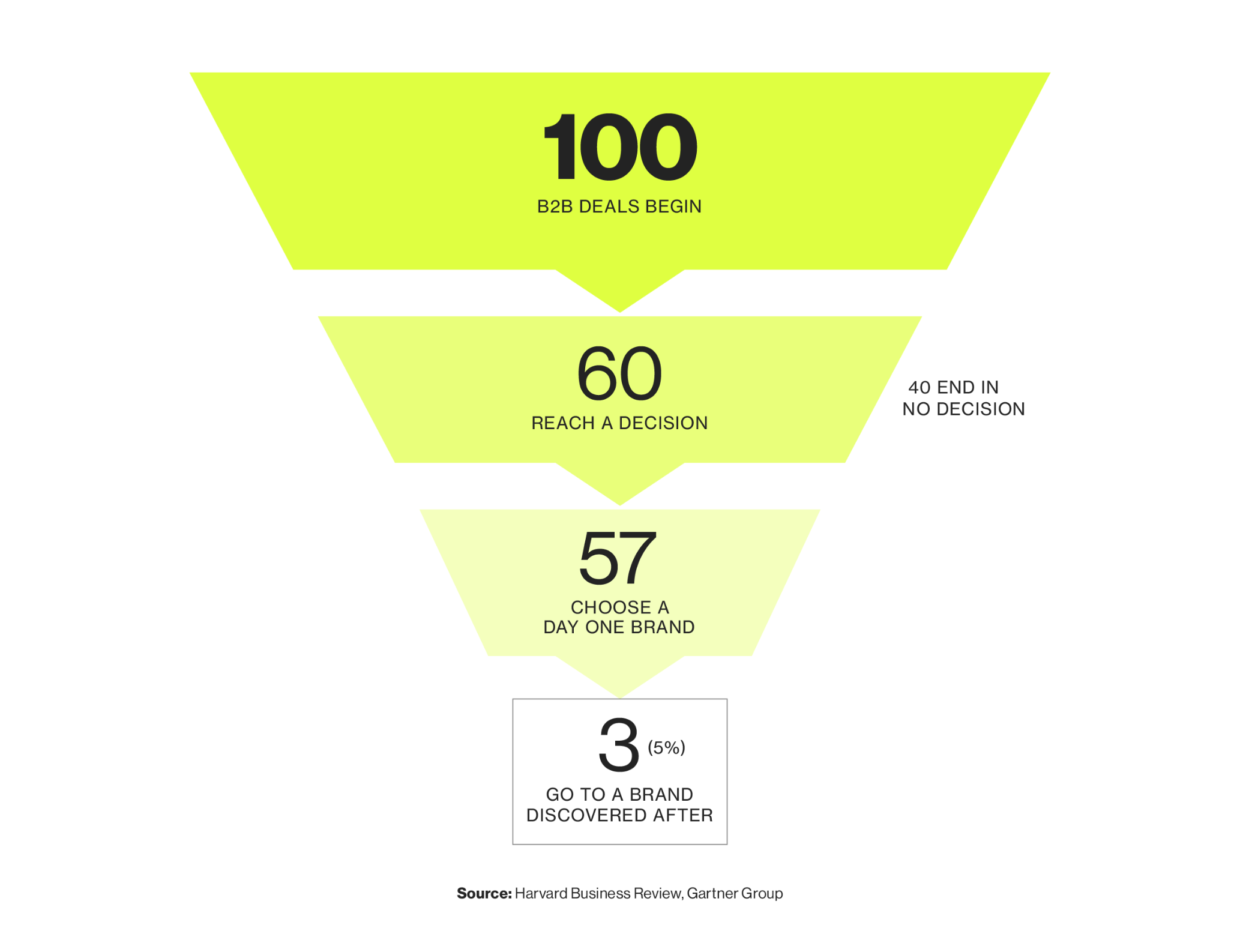
In enterprise software the shortlist is assembled early, informally, and long before any RFP is issued. Harvard Business Review found 80% of B2B buyers already have vendors in mind before research begins, and 90% choose from that first list. So when is the decision actually made?
What the data says about how B2B buyers build a shortlist
The data on how enterprise buyers actually make decisions is well established, and it is unforgiving.
According to Harvard Business Review, 80% of B2B buyers have a set of vendors in mind before they do any research. Ninety percent of them will choose a vendor from that initial list. If your brand is not in the consideration set before the buying process begins, if you are discovered only after research starts, your odds of winning the deal collapse to roughly 5%.
That is not a disadvantage you can sell your way out of. No amount of sales activity, product superiority, or pricing flexibility moves a 5% number. Product superiority in particular is a weakening defense, which is the argument in product differentiation in B2B SaaS.
Why close to 40% of B2B buying decisions end in no decision
All of that assumes a deal happens at all. Gartner estimates that close to 40% of B2B buying decisions end in no decision. The committee cannot reach consensus, the process stalls, and nothing is purchased.
Read those two figures together and the picture sharpens. The buying journey that demand generation was designed to optimize frequently produces no outcome whatsoever, and when it does produce one, the winner was chosen from a list drawn up before the journey started. Together those figures make the commercial case for brand as the competitive moat in enterprise SaaS.
Why the enterprise shortlist rarely changes once it is set
In enterprise software these dynamics are especially severe. The purchase is high-stakes, technically complex, and evaluated by a committee rather than an individual. The sales cycle stretches across months, sometimes years. And the shortlist, the set of vendors the committee agrees to evaluate, is assembled early and often informally, long before a formal RFP is issued.
Once that list is set, it rarely changes. Too much internal political capital has been spent building consensus around it. A vendor that arrives after the shortlist is formed is not late. It is irrelevant.
This is the reality most SaaS go-to-market models fail to account for. The billions spent on demand generation, intent data, and sales acceleration are all designed to compete during the buying journey. But the buying journey is not where the decision is made. The decision, the real one, the one that determines who gets evaluated and who does not, is made before the journey begins. It is made at the point of memory.
The real competition in enterprise software is not for the deal. It is for the shortlist.
What a Day-One brand actually means
When a CTO's team identifies a need, when a CFO flags a capability gap, when a business unit raises its hand and says we need a solution for this, the names that come to mind in that moment are the names that will be evaluated. Not the names with the best product. Not the names with the most compelling ROI calculator. The names the buyer already knows, already trusts, and already associates with the problem they are trying to solve.
That is what it means to be a Day-One brand. Not the biggest brand. Not the most famous. The brand that is already present in the buyer's memory when the category becomes relevant to them, across as many use cases and buying scenarios as possible.
The breadth matters as much as the presence. A company known for one capability enters the buyer's mind for one type of need. A company understood across its full range enters for many. Every buying scenario you are not remembered in is a shortlist you were never on. Building that presence before the need arises is what the 95/5 rule in B2B is about.
In enterprise software, if you are not known early, you are not chosen later.
Adapted from Day 1 or Die, Part 1 of a four-part series on brand in enterprise SaaS.