00:00
/
00:00
Why enterprise SaaS brand ideas fail inside the business
Enterprise SaaS companies fund product marketing generously and leave the company-wide story to nobody. The result is a market that knows you for one product and one use case even when you sell far more. So why does the brand idea never survive contact with the business?
Why enterprise SaaS buyers only know one part of what you do
Because the SaaS demand generation model is oriented around capturing demand at the point of sale, SaaS companies systematically underinvest in the thing that creates demand in the first place. The prior relationship. The familiarity, the trust, and the association between the company and the problems it solves.
Product marketing, the dominant function in most SaaS organizations, is structurally incentivized to promote the product under its mandate and nothing else. Each product team tells its own story, to its own audience, in its own way. Nobody is responsible for telling the organization-wide story. Nobody is building a coherent picture of what the company stands for, what it is capable of across its full breadth, or why it matters beyond any single use case.
The consequence is visible in the market today. Most enterprise SaaS companies have weak brands. Not weak in the sense that their logos are unattractive. Weak in the sense that buyers have a narrow, fragmented understanding of what these companies actually do. They are known for one product, one capability, one use case, even when they offer far more. The brand, to the extent it exists at all, is an accidental byproduct of years of product-level messaging that was never designed to add up to anything larger. That gap is the subject of the wider case for brand as the competitive moat in enterprise SaaS.
In enterprise SaaS, your brand is smaller than your business.
Why business unit incentives keep the brand small
There is a structural reason this keeps happening. Business unit leaders control the budget. They are not incentivized to promote the brand. They are incentivized to promote their product. So they run their own campaigns with their own messaging, disconnected from any overarching brand idea.
Product marketing, the most-funded communications function in most organizations, becomes a vehicle for fragmented messages. The brand idea, no matter how strong, never reaches the market with consistency. And the buyer, encountering a dozen interactions across twelve months, forms no coherent memory at all.
Why fragmented messages destroy recall in long sales cycles
There is a hard truth about enterprise B2B sales cycles. They are long. A buyer does not decide to change automation vendors on a Tuesday and sign a contract by Friday. The decision takes months, sometimes years. It involves multiple stakeholders across multiple functions and it requires dozens of interactions, including sales conversations, product demonstrations, customer success onboarding, case studies, analyst briefings, executive presentations, and word of mouth from peers.
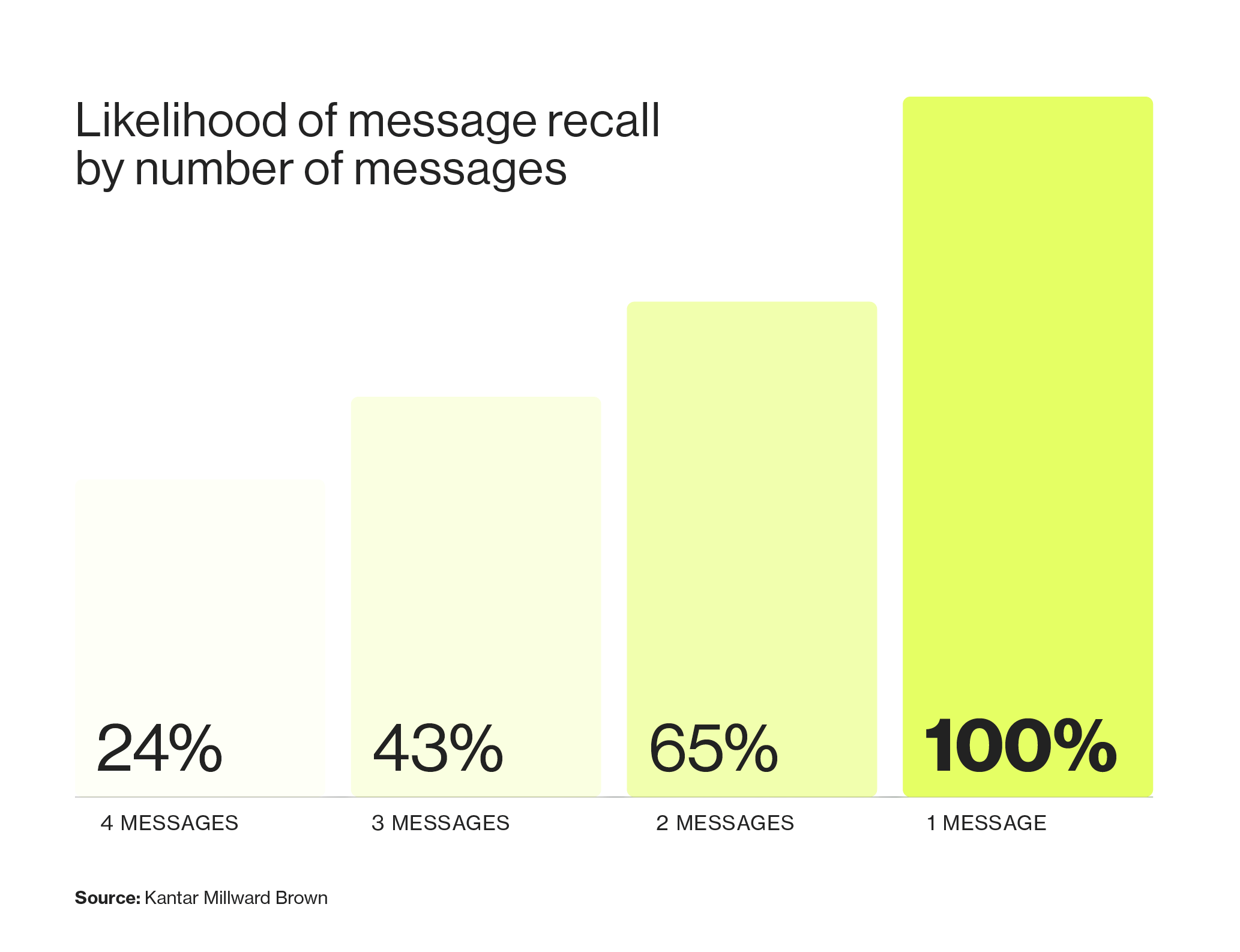
Each of those interactions is a moment where a belief forms. Each one either reinforces the memory you are trying to build, or contradicts it. Research from Kantar Millward Brown shows why consistency across those moments matters. An advertisement communicating a single message achieves a maximum of 100% recall. Add a second message and recall drops to 65%. A third drops it to 43%. By four messages, recall falls to 24%.
Fragmented signals destroy memory. Consistent signals build it.
Why most brand ideas fail on altitude, not ambition
Most brand strategies and campaign platforms are positioned at the mission, vision, and purpose level. They articulate what we believe in, not how we compete. They speak in the language of transformation, empowerment, and possibility, words so universal that any company in the category could claim them without contradiction.
When every technology company tells you it will transform your operations, the positioning gives a product marketer in a specific segment nothing they can use. It is not that the business ignores the brand. It is that the brand has given the business nothing worth adopting.
The three levels of brand operationalization
The solution is operationalization. Not as a brand management process. As a commercial imperative.
Ideally this starts with a formal brand strategy, one built bottom-up from segment and business unit realities, so that every part of the organization can see how their work connects to the larger story. Not every marketing leader controls brand strategy. Many are heads of marketing for a business unit, working within a brand strategy set elsewhere. In that case the same principle applies to a campaign platform. A single, durable brand idea that defines how you compete, which segments to pursue, which competitors to challenge, and what proof you offer.
The brand idea is not the campaign. The campaign is one expression of it. Operationalization happens at three levels, each more ambitious than the last.
- Marketing. All of it, including product marketing, content, thought leadership, research, and sales enablement. The brand idea needs to become the organizing principle for how every marketing function communicates. That means unified voice and expression standards cascading from the brand idea into every brief, every article, every deck. It means a product marketer writing a campaign for a specific segment is not just driving pipeline, they are simultaneously reinforcing the company's broader story. Over time every campaign becomes both a product campaign and a brand campaign, not because it is mandated but because the idea is clear and specific enough that it guides the work naturally.
- The client-facing organization. Customer experience, customer success, technical support, and sales. These functions interact with buyers and customers more frequently than any campaign ever will. If the brand idea does not inform how they operate, how quickly they respond, how they onboard, how they handle problems, how they frame conversations, the gap between what marketing says and what the customer experiences destroys the memory the campaign worked to build. Operationalizing the brand idea at this level means developing experience principles and service standards derived from the brand idea itself. Not a poster on a wall. A standard that changes behavior.
- Core business strategy. Product roadmap decisions, business unit priorities, and how success is measured and rewarded. This level is the hardest and the most consequential. Most organizations incentivize business unit leaders to grow their product line. They do not incentivize them to grow the brand. The result is predictable. The brand is everyone's second priority, which means it is no one's first. Changing this requires connecting the brand idea to business strategy, to which segments the company chooses to win, which competitors it chooses to challenge, and which product investments it chooses to make. When a business unit leader aligns their roadmap to the brand's core pillars, and when their OKRs include the brand's growth alongside the product's, the incentive structure changes. Promoting the brand becomes part of their job, not a distraction from it.
What brand citizenship looks like in practice
This is not a guidelines document downloaded once and forgotten. It is not a memo from the CMO. It is a structural change to how work gets briefed, measured, and evaluated, one that makes telling the company's story part of everyone's responsibility, at every level of the organization.
Stated plainly, the shift moves you from treating campaigns as the sole carrier of brand perception to activating every signal the organization produces, paid and organic, marketing and operational, to tell one coherent story about who you are and what you are capable of. Cluster 3 of the brand strength assessment scores how far you have taken this.
In enterprise software, brand is not a department. It is the operating system.
Adapted from Day 1 or Die, Part 1 of a four-part series on brand in enterprise SaaS.