00:00
/
00:00
Not all B2B media formats build brand memory
Reach and frequency tell you how many people were exposed to a B2B campaign and nothing about how many will remember it. Static display and brand video register identically in a media plan and produce completely different commercial effects. So which formats actually leave something behind?
Why reach and frequency understate what a B2B media plan delivers
Most media planning optimizes for reach and frequency, which are distribution metrics that measure exposure. Exposure is only the first variable.
Impact is exposure multiplied by attention, multiplied by encoding, multiplied by retention. Reach and frequency solve the first. They say nothing about the other three.
An impression that is glanced at and forgotten within hours is not the same as one that commands attention, encodes through narrative and emotion, and persists for weeks. Both register as one impression in your media plan. They are not remotely equal in their commercial effect. This is the problem of memory decay. Some formats decay almost immediately. Others compound. Memory is the raw material of brand as the competitive moat in enterprise SaaS.
Which B2B media formats build durable memory
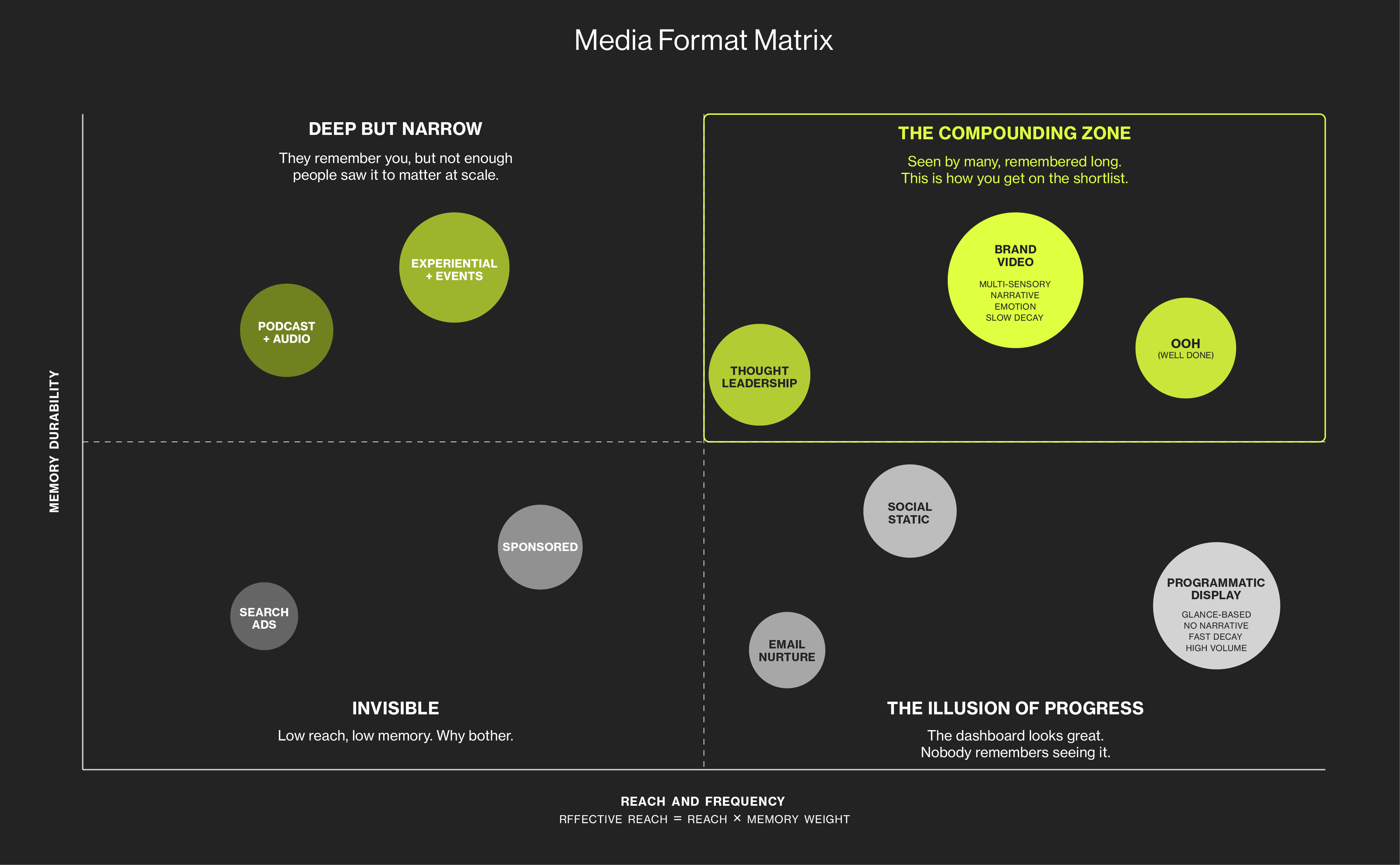
Video encodes through multiple sensory channels at once. Visual and audio create stronger neural traces than either alone. Temporal structure gives the brain a framework for retrieval. Emotion increases both the probability and the durability of recall.
Out-of-home, done well, builds memory through physical presence and creative impact. Thought leadership earns attention on the strength of the thinking rather than the placement. These are memory builders, and they sit in the zone where enough people see the work and enough of those people remember it. That combination is how you get on the shortlist.
Podcasts, audio, and experiential events build memory too, but reach too few people to matter at scale on their own. They are deep and narrow. Use them knowing which half of the equation they solve. What you put into those formats is a separate decision, covered in B2B soft selling.
Why programmatic display decays before it compounds
Static digital display, the programmatic banner served into a cluttered feed, is glance-based at best and invisible at worst. No narrative. No emotion. No dwell time. It registers as an impression and vanishes almost instantly.
This is where the vast majority of B2B brand spend goes. It is the format least capable of building durable memory.
The planning model most B2B companies use, reach multiplied by frequency, is incomplete. A more honest model would be effective reach, which is reach multiplied by memory weight, where memory weight varies by format. If your media plan is mostly display, you are optimizing for visibility that decays before it can compound. The dashboard looks good. Nobody remembers seeing the work.
Why distinctiveness makes every dollar of B2B brand spend work harder
There is a third variable that determines how much memory each impression creates. Distinctiveness.
A brand with distinctive visual assets, a distinctive tone, and distinctive creative executions gets more memory per impression than a brand that looks and sounds like every other company in the category. The Ehrenberg-Bass Institute's research on distinctive brand assets confirms it. Brands that invest in building and consistently deploying distinctive assets achieve higher recall, higher recognition, and stronger mental availability than competitors spending equivalent amounts on generic creative.
In enterprise B2B this multiplier is especially powerful because almost nobody uses it. The creative conventions of the category, the blue gradients, the stock photography, the abstract language about transformation, are so uniform that any brand willing to break them earns an outsized share of memory at no additional media cost.
Put your B2B advertising on a wall next to your competitors, step back, and squint. If you cannot tell which one is yours, your spend is subsidizing the category rather than building your brand.
Distinctiveness is the force multiplier that makes every dollar of brand spend work harder. It is the reason a challenger brand with a fraction of the budget can outperform an incumbent spending ten times more. How much of the media budget should carry brand at all is set by the 95/5 rule in B2B.
You do not need the biggest budget in enterprise software. You need the most distinctive one.
Adapted from Day 1 or Die, Part 1 of a four-part series on brand in enterprise SaaS.