00:00
/
00:00
Most B2B SaaS content is written for the wrong buyer
Almost every asset a B2B SaaS marketing team produces assumes the reader is already evaluating solutions. For buyers with no active need, that content does not register at all. So what do you say to someone who has no reason to care yet?
Why product-centric content does not reach out-of-market B2B buyers
Most enterprise SaaS organizations have no answer to the question of what to say to buyers who are not buying. The overwhelming majority of what they produce, including the product one-pagers, the feature comparison sheets, the ROI calculators, and the case studies with customer logos and percentage improvements, is designed for people who are already in the buying process. That silence is expensive, because the gap it leaves is where brand as the competitive moat in enterprise SaaS is won or lost.
It speaks in the language of the category. It assumes the reader has a problem, knows they have a problem, and is actively evaluating solutions.
For the 5% of B2B buyers in market, product content is useful. For the 95% who are not, it does not exist.
It is written in a language they do not speak, about a problem they do not have, in a format they have no reason to engage with. Their attention for anything category-specific is effectively zero. The size of that audience is set out in the 95/5 rule in B2B.
They will scroll past your LinkedIn ad about API throughput in the same way you scroll past an ad for industrial compressors. Not with hostility, but with the complete indifference of someone for whom the message is irrelevant to their life right now.
The difference between hard selling and soft selling in B2B
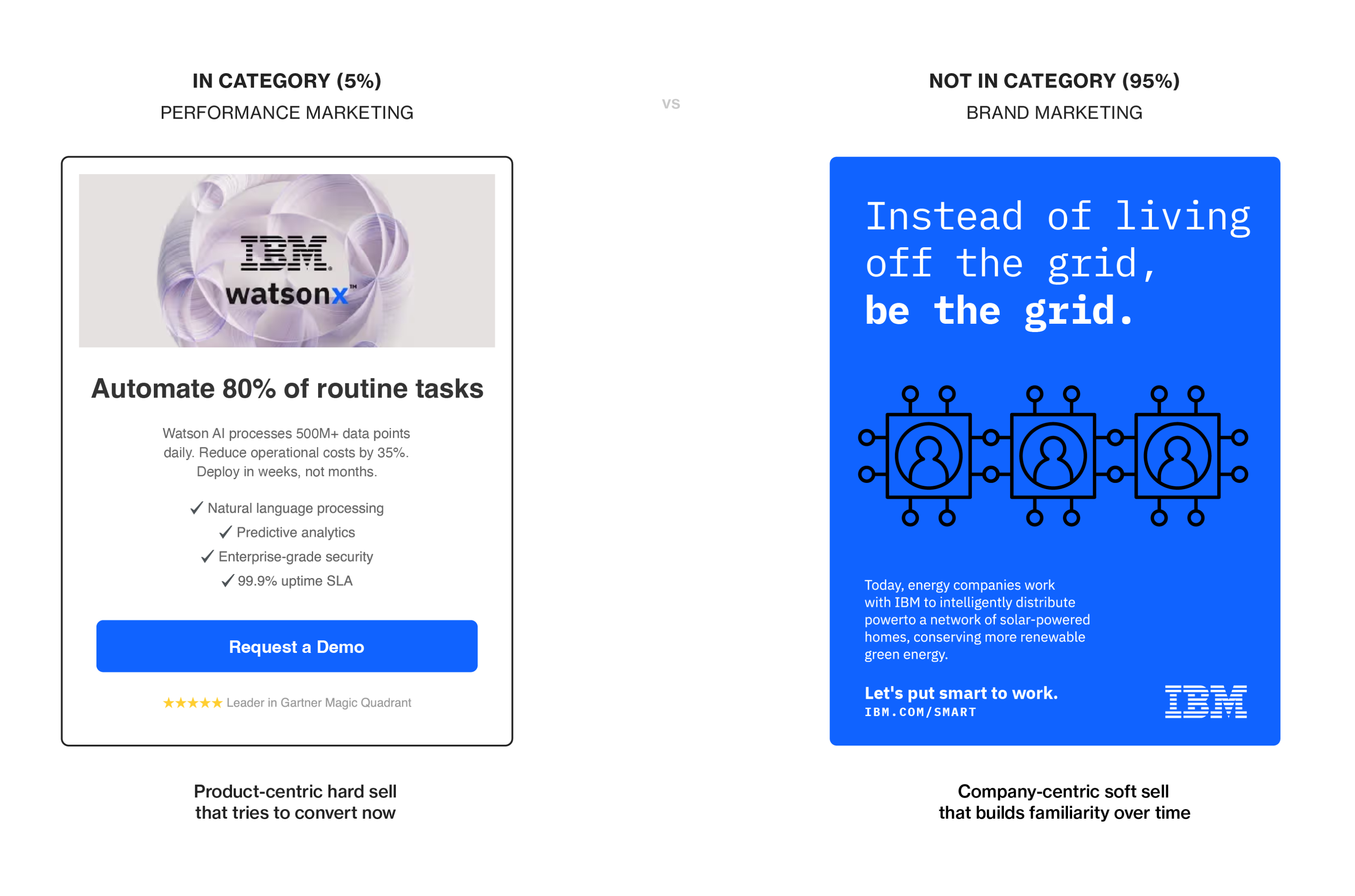
The shift required is from product-centric hard selling to company-centric soft selling.
Hard-sell messages try to convert buyers who are in the category now. They promote features, cite proof points, and push for action. That work has a job and it does it well.
Soft-sell messages build familiarity with the brand over time. Not just warm feeling, but a working understanding of what the company does, how it is different, and in what contexts it is relevant. The goal is that when a future customer eventually enters the market, the brand is already known, already trusted, and already associated with the problem they need to solve.
What changes when you write for future customers
The two jobs differ on every dimension that matters, and treating them as one job is what produces content nobody outside the buying process will read.
- The audience. Hard sell targets those in the category now. Soft sell targets the total addressable market.
- The objective. Hard sell converts existing customers. Soft sell creates future ones.
- The method. Hard sell uses product-centric messages that nudge people to buy now. Soft sell uses company-centric messages that build familiarity over time.
This is not a call to abandon product marketing. Product content serves a vital role in converting the buyers who are actively evaluating. The problem is that in most SaaS organizations, product marketing content is the only content. There is nothing for the 95%.
How to audit your B2B content for the buyers you are missing
Run the audit and the imbalance becomes impossible to argue with.
Take every piece of communication your organization produces. Every ad, every email, every landing page, every social post, every piece of sales collateral. Sort it into two categories. Designed for someone with an active need, and designed for someone without one.
Almost everything will fall into the first category. Almost nothing into the second. That is the gap, and it is a content problem before it is a media problem. You cannot buy your way to familiarity with material that assumes the reader is already shopping. Whether the material you make instead gets remembered depends on format, which is covered in B2B media formats.
Adapted from Day 1 or Die, Part 1 of a four-part series on brand in enterprise SaaS.