00:00
/
00:00
A B2B campaign aimed only at people currently shopping is aimed at a small fraction of its category. Broad reach is not waste, it is what makes the rest of the budget work harder. So how many people should a campaign reach, and how often should it reach them?
How wide a campaign should go
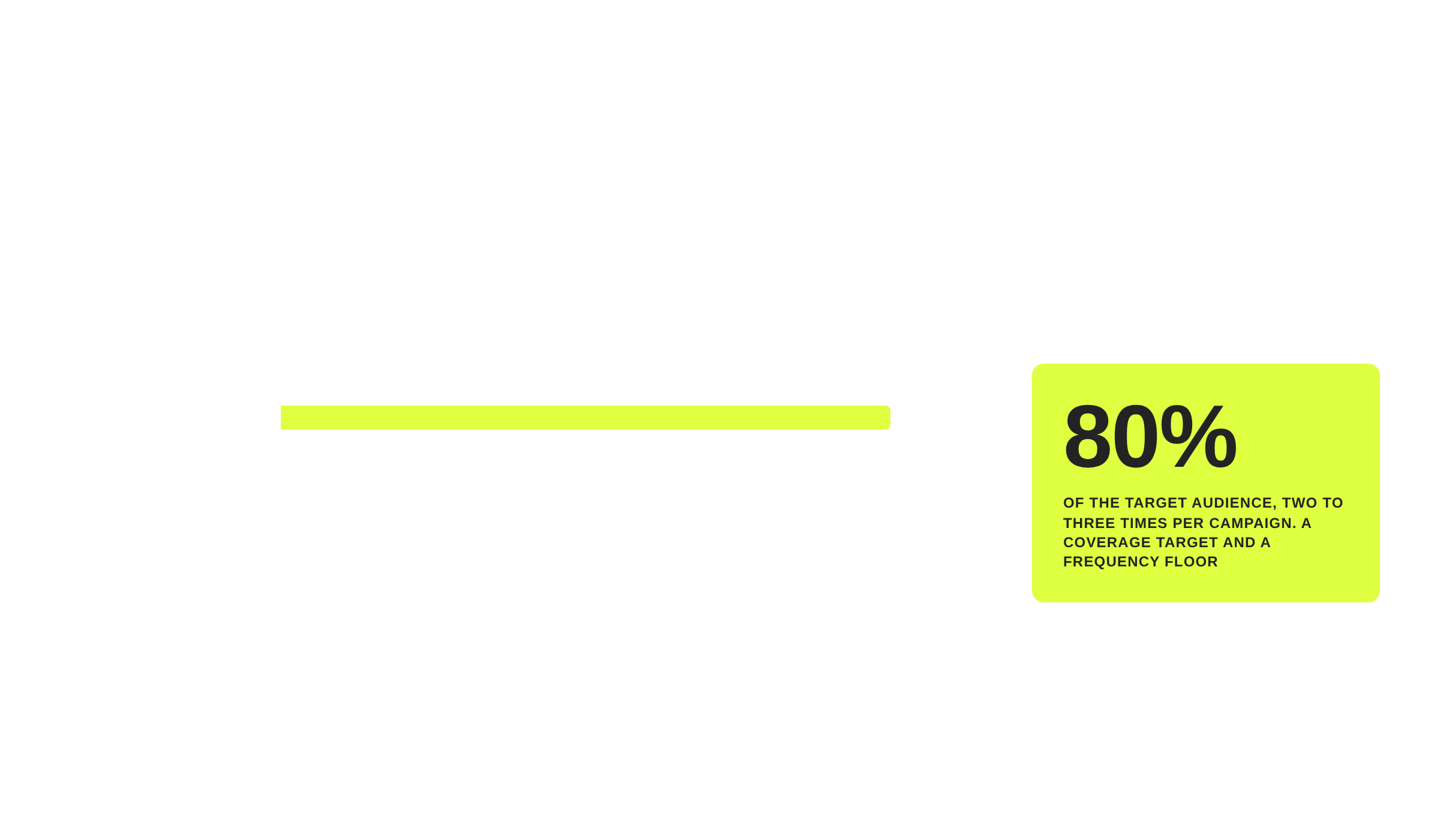
The instruction from the effectiveness research is specific enough to plan against. Aim to reach 80% of your target audience two to three times per campaign. Source: Les Binet and Peter Field, The Long and the Short of It, IPA, figures 21 and 18.
Both halves of that matter, and together they are the hardest constraint in how to compete when competitors outspend you. Eighty percent is a coverage target, and it is high on purpose, because the people who are hardest to reach are the ones least likely to already know you. Two to three exposures is a frequency floor, because one impression against someone with no existing familiarity does very little.
A campaign that reaches 30% of a B2B category five times is worth less than one that reaches 80% of it twice.
Why targeting the whole market beats targeting buyers
The temptation with a small budget is to narrow the audience, on the reasoning that a tighter target wastes less. The effectiveness data says the opposite.
Campaigns were compared by who they targeted, and measured on how many very large business effects they produced. Campaigns aimed at the whole market outperformed both campaigns aimed at new customers and campaigns aimed at existing customers, on business effects and on total effects. Source: Les Binet and Peter Field, The Long and the Short of It, IPA, figures 21 and 18.
Your long-term audience is every potential buyer in the category, not the subset currently raising a hand. The more people who see your advertising, the more effective that advertising becomes, which is the opposite of how a targeting tool encourages you to think.
What broad reach does to efficiency
The counterintuitive part is that going wider improves the economics rather than degrading them.
Annualized efficiency of excess share of voice rises as reach broadens. In plain terms, the same share of category advertising converts into more growth when it is spread across more of the market, so the money works harder at 80% coverage than at 30%.
That is why broad reach is not a luxury bought after the efficient spending is done. It is the condition that makes the efficient spending efficient.
What narrow targeting actually reaches
It helps to see the size of the pool each approach is fishing in. Advertising bought against declared intent reaches under 5% of the market at any one time. Advertising built for reach can address 100% of it.
Those are not two strategies with different costs. They are two strategies with different maximum sizes, and one of them has a ceiling twenty times lower than the other. A plan can be perfectly executed inside that 5% and still never grow the business, because growth requires people who are not in the 5% today.
The proportion of B2B buyers who are out of market at any given time, and why, is covered in the 95-5 rule.
Why both demand pools need funding at once
Large brands are not simply outspending you, they are buying two things at the same time.
They convert the demand that exists today, which produces this quarter's revenue. And they build a pipeline of demand for tomorrow, which produces the revenue that arrives after this quarter. Smaller brands, pushed toward cheaper intent-based channels, usually fund only the first and then wonder why the second never appears.
Existing demand is a pool you draw from. Future demand is a pool somebody has to fill.
The two instructions worth pinning to the wall
The research reduces to one thing to do and one thing to stop doing, and they are easier to hold onto than the charts behind them.
Do aim to reach 80% of your target audience two to three times per campaign. Do not limit your audience to existing customers, and do not limit it to new customers either. Both of those look like discipline and both of them cap what the campaign can achieve before it runs.
The second instruction is the harder one, because narrowing is what every targeting interface is built to help you do, and because a narrow campaign produces better-looking efficiency metrics while producing less growth.
What to do with the number
Set 80% coverage at two to three exposures as the target before you choose channels, not after, because it is a constraint that rules out most narrow plans immediately.
Then check what your current plan actually reaches. Most B2B media plans, measured honestly, cover a fraction of their category, and the gap between that fraction and 80% is the real size of the growth problem.
Which channels deliver coverage at what cost is covered in TV and print deliver 89% of advertising profit. Whether the advertising registers once it arrives is covered in 89% of ads are ignored.
This article draws on How to build a big brand on a small marketing budget, our report on cost-effective brand building.



Being outspent is a media problem before it is a brand problem. Your competitors are not smarter than you, they simply reach more of the market more often, and that advantage compounds quietly for years. Six decisions decide how far a smaller budget goes. So where does the money actually have to land?