00:00
/
00:00
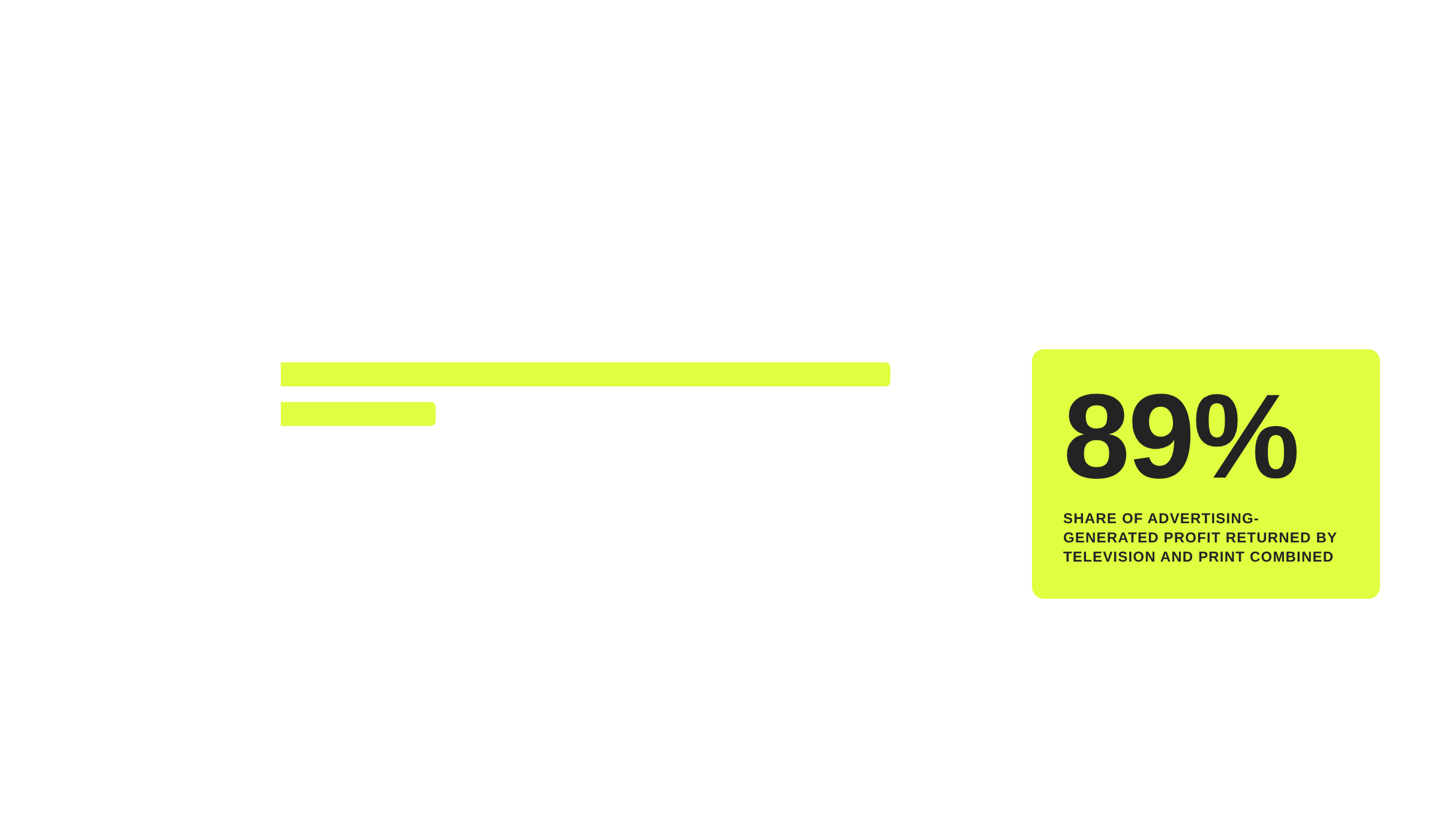
Advertising profit is concentrated in two channels, and neither of them is digital. Television and print together return 89% of all advertising-generated profit, which puts a ceiling on what a digital-only plan can earn. So how should a small budget read a ranking it cannot afford to act on?
Why mass media delivers the widest reach
Large advertisers buy television and other mass media for one reason before any other. It reaches more of the category, faster, than anything else available, and that head start is the problem set out in how to compete when competitors outspend you.
The viewing data behind that is now dated and was collected under unusual conditions, so treat it as illustrative rather than current. Broadcaster television accounted for 64% of video consumed per day, against average daily video time of 5 hours 16 minutes across all individuals and 4 hours 54 minutes among 16 to 34 year olds. Source: 2020, BARB, Broadcaster stream data, comScore, IPA Touchpoints 2020 (lockdown), Rentrak.
The proportions matter more than the absolute numbers. Mass media assembles an audience that is not selected by intent, which is the only way to put a message in front of people who are not looking for you.
How advertising profit splits across channels
Reach is the input. Profit is the output, and the gap between the two is what makes this data useful.
Television and print together deliver 89% of all advertising-generated profit. The full split runs as follows.
- Television: 71%
- Print: 18%
- Online video: 4%
- Radio: 3%
- Out of home: 3%
- Online display: 1%
Sources: Profit Ability: the business case for advertising, November 2017, and the Ebiquity ROI campaign database, February 2014 to May 2017, with Gain Theory. Campaign observations: 1,954.
Nearly two thousand campaigns is a large enough base that the ordering is not noise. Read it as a statement about what kinds of advertising generate profit rather than a shopping list, because the shopping list is unbuyable for most companies reading it.
Channel choice sets the profit ceiling on an advertising budget before anyone writes a line of copy.
Which channels win on which objective
A single ranking hides the fact that channels are good at different things. Ebiquity scored ten media against four separate objectives in 2020, and the orders barely resemble each other.
- Getting ads noticed: cinema leads, then television, then radio and out of home level on third.
- Low-cost audience delivery: radio leads, then out of home, then newspapers and social media level on third.
- Maximizing campaign reach: out of home leads, then television, then radio.
- Increasing campaign ROI: television leads, then radio, then newspapers and magazines level on third.
Source: Re-evaluating media for recovery, Ebiquity, 2020.
Cinema tops the first list and comes last on the other three. Radio is second or third on three of the four and never first except on cost. A channel that looks weak against one objective can be the right buy against another, which is why a plan assembled from a single ranking usually underperforms.
Why adding channels raises campaign ROI
The last finding is the most useful one for a constrained budget, because it costs nothing to act on. Each additional channel added to a campaign increases its effectiveness, and channels produce synergy effects on return on investment rather than simply dividing the same result into smaller pieces.
Source: Media effectiveness and the role of motion picture, Analytic Partners, 2016 and 2020.
The practical reading is that spreading a fixed budget across more channels tends to beat concentrating it in one, and that owned assets and channels should be worked as hard as paid ones, because they add surface without adding spend.
What to do with a budget that cannot buy television
The instructions attached to the ranking are about how to use channels rather than which to buy, and three of them apply at any budget.
- Use mass media to promote emotional, brand-based advertising at scale, because that is what those channels are good at and what the profit data reflects.
- Use digital media to drive more specific messages to targeted audiences, which is a different job from the first and should not be asked to do it.
- Hit people across multiple platforms throughout the campaign rather than concentrating weight in one.
Two decisions follow for a budget that cannot buy the top of the list.
First, buy audience rather than intent wherever the plan allows it. The channels at the top of the profit ranking share that property, and it is the property, not the channel, that is doing the work.
Second, spread the plan. The synergy finding says the cheapest available lift is an extra channel, not more weight behind the one you already use, and owned channels count toward that as much as paid ones do.
What the highest-reach digital format costs to produce at scale is covered in shoot a year of brand video in one production run. How much of the budget should sit behind brand work at all is covered in how to split a B2B marketing budget.
This article draws on How to build a big brand on a small marketing budget, our report on cost-effective brand building.



Being outspent is a media problem before it is a brand problem. Your competitors are not smarter than you, they simply reach more of the market more often, and that advantage compounds quietly for years. Six decisions decide how far a smaller budget goes. So where does the money actually have to land?